Every organisation has been there. A critical file goes to the wrong destination. A sync job fails silently at 2 AM and nobody notices until the morning stand-up. The one person who knows how the data pipeline works is on holiday. Sound familiar?
Data movement is one of those problems that sounds simple until you're living it. And for most businesses, the solution has been a patchwork of scripts, manual transfers, and institutional knowledge held by one or two people. That's not a strategy — it's a liability.
PRISM (Platform for Real-time Intelligent Streaming and Management) from WingerX is built to change that. Here's what it does, why it matters, and whether it's the right fit for your organisation.
The Problem Nobody Talks About Openly
Modern organisations move enormous volumes of data every day between cloud platforms, file servers, data warehouses, remote sites, and edge devices. The challenge isn't just the volume; it's the fragility.
Three problems show up again and again:
Knowledge bottlenecks. When only one or two people understand the data infrastructure, the whole operation grinds to a halt the moment they're unavailable. This is a single point of failure dressed up as job security.
Human error. Wrong file versions. Overwritten records. Silent failures that don't surface until the damage is done. Manual processes are inherently unreliable at scale.
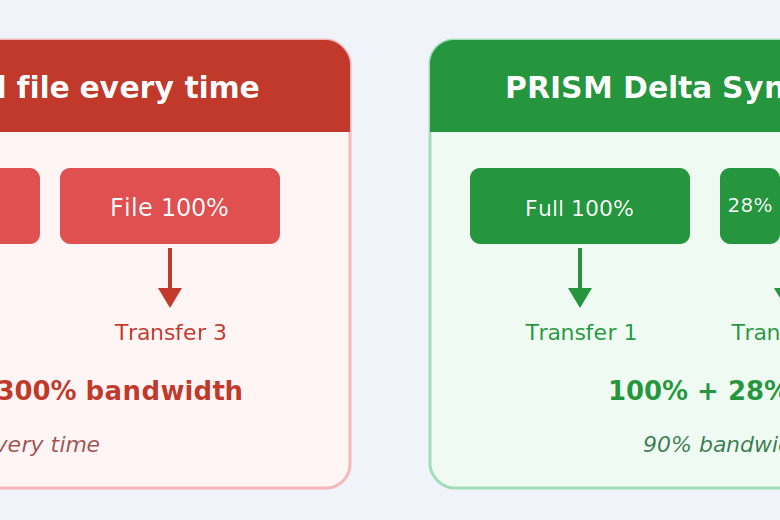
Wasted bandwidth. Traditional sync tools re-send entire files even when only a tiny fraction of the data has changed. For large files or high-frequency transfers, this adds up to enormous cloud egress costs.
What PRISM Does Differently
PRISM is designed around one core principle: set it up once, and never touch it again.
Smart Delta Sync
Instead of re-sending whole files, PRISM identifies exactly what changed and transfers only those parts. The result is up to 90% bandwidth savings and transfers that are 10x faster than traditional sync — with near-zero latency.
Reliable by Design
Dropped connection? PRISM picks up exactly where it left off. Server goes down? Other nodes in the MESH network take over instantly. The system is self-healing — it detects corrupted or incomplete transfers and automatically re-sends what's needed. No duplicate files, no manual intervention.
Enterprise-Grade Performance
PRISM is built to handle serious workloads: 99.99% high availability, guaranteed p99 SLA, and support for over 10,000 queries per second. These aren't aspirational numbers — they're contractual commitments.
Security That Doesn't Slow You Down
Every file is encrypted with SSH keys before it leaves the source, compressed to reduce transfer size, and verified byte-by-byte on arrival. A full audit trail logs every file movement with timestamps, making compliance straightforward. Permissions are preserved automatically — no manual re-setup at the destination.
Works Everywhere
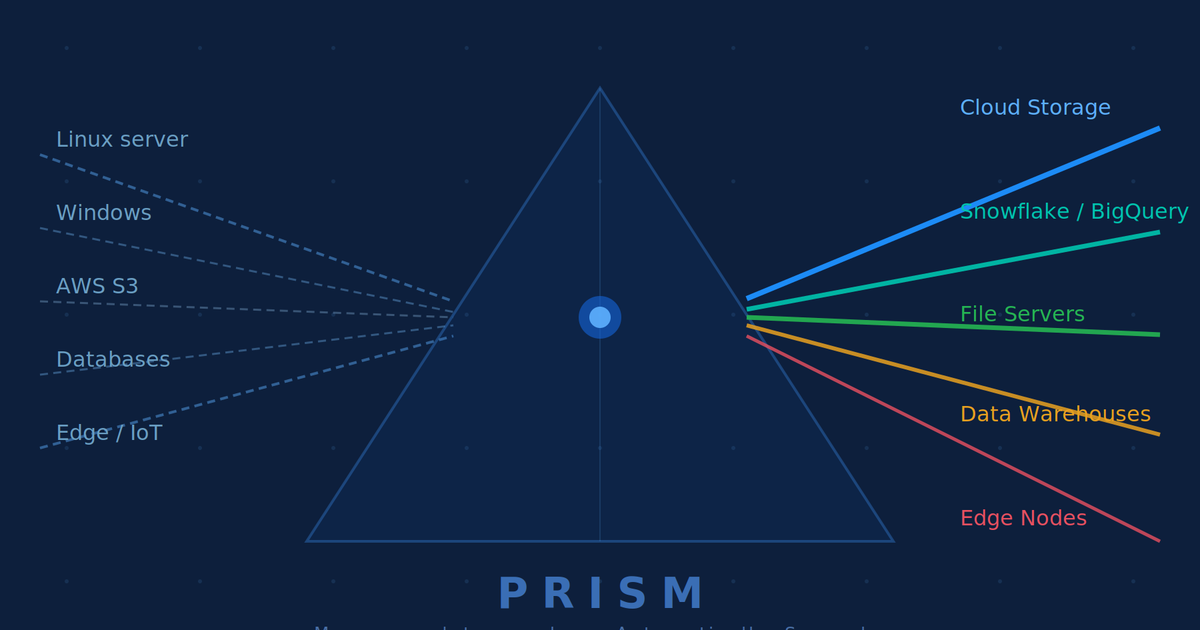
Windows to Linux. Linux to cloud. On-premises to AWS S3, Azure, or Google Cloud. PRISM connects every major OS, file server protocol (NFS, SMB/CIFS), data warehouse (Snowflake, BigQuery, Redshift), and edge/IoT endpoint. One tool. Any direction.
No IT Degree Required
A single dashboard gives a traffic-light view of everything happening across your data infrastructure. Setting up a new sync rule is as simple as: "copy this folder to that cloud, every night." If you can use a website, you can use PRISM.
The Business Case in Numbers
The savings materialise immediately:
- 75% reduction in cloud egress fees through delta sync
- 85% less IT firefighting — your team works on real problems, not data errors
- Infinite scalability — the same tool handles 10 files or 10 million without upgrades or re-architecture
What's on the Roadmap
PRISM today ships with smart sync, MESH networking, SSH encryption, auto-compression, auto-resume, and a full dashboard. Coming next:
- Predictive Staging — PRISM learns your usage patterns and pre-moves data before you ask for it
- Malicious File Scanner — every file scanned before copying, with options to include or quarantine suspicious content
- Edge & IoT Ready — full support for 5G sites, factory floors, and remote devices
Frequently Asked Questions
What is PRISM and who makes it? PRISM (Platform for Real-time Intelligent Streaming and Management) is an enterprise data movement platform developed by WingerX. It automates the transfer and synchronisation of data across any system, OS, or destination — securely and without ongoing manual effort.
How is PRISM different from traditional file sync tools? Most sync tools re-send entire files on every transfer cycle. PRISM uses delta sync — it identifies only the bytes that have changed and transfers those. This reduces bandwidth consumption by up to 90% and makes transfers up to 10x faster.
Do I need a dedicated IT team to manage PRISM? No. PRISM is designed so that a non-technical user — such as an office manager — can set it up and manage it. The dashboard uses a simple traffic-light status system: green means good, amber means check, red means action needed. There are no logs to read or scripts to maintain.
What happens if the internet connection drops during a transfer? PRISM automatically resumes from the exact point where it stopped. Nothing is lost, and nothing is sent twice. The system is fully fault-tolerant.
Which cloud platforms and systems does PRISM support? PRISM supports cloud storage (AWS S3, Azure Blob, Google Cloud Storage), file servers (NFS, SMB/CIFS, local drives), data warehouses (Snowflake, BigQuery, Redshift), and MESH/edge nodes including IoT and 5G sites. It works across Windows, Linux, and Mac.
Is my data secure in transit? Yes. Every file is encrypted using SSH key encryption before it leaves the source, meaning even if data is intercepted in transit it is completely unreadable. Encryption is end-to-end, and permissions are preserved identically at the destination.
Can PRISM send data to multiple destinations simultaneously? Yes. A single source can be synced to cloud storage, an office file server, and a remote site — all at the same time, in a single operation.
How does PRISM ensure files arrive intact? Every transferred file is verified on arrival. If even a single byte is incorrect, PRISM automatically detects the discrepancy and re-sends the file. You don't need to check manually.
What are the performance guarantees? PRISM offers 99.99% high availability, a p99 SLA (meaning 99% of data is processed within the agreed time limit), and support for over 10,000 queries per second.
What file types does PRISM support? All of them. Databases and spreadsheets (Excel, SQL, CSV), documents and emails (Word, PDF, Outlook), images and video (photos, MP4, RAW files), and any combination of the above — all handled identically.
How does PRISM handle files that fail during transfer? PRISM is self-healing. It automatically detects failed or corrupted transfers and re-sends only what is needed. There are no manual recovery steps.
Is there an audit trail for compliance purposes? Yes. Every file transfer is logged with a timestamp, creating a complete audit trail suitable for regulatory compliance requirements.
What is the MESH network? MESH is PRISM's multi-path delivery architecture. Instead of relying on a single server route, data travels across multiple nodes simultaneously. If one node fails, others continue the transfer without interruption or downtime.
How does pricing work? For pricing information, contact WingerX directly at marketing@wingerx com or visit wingerx.com